Switch Audience
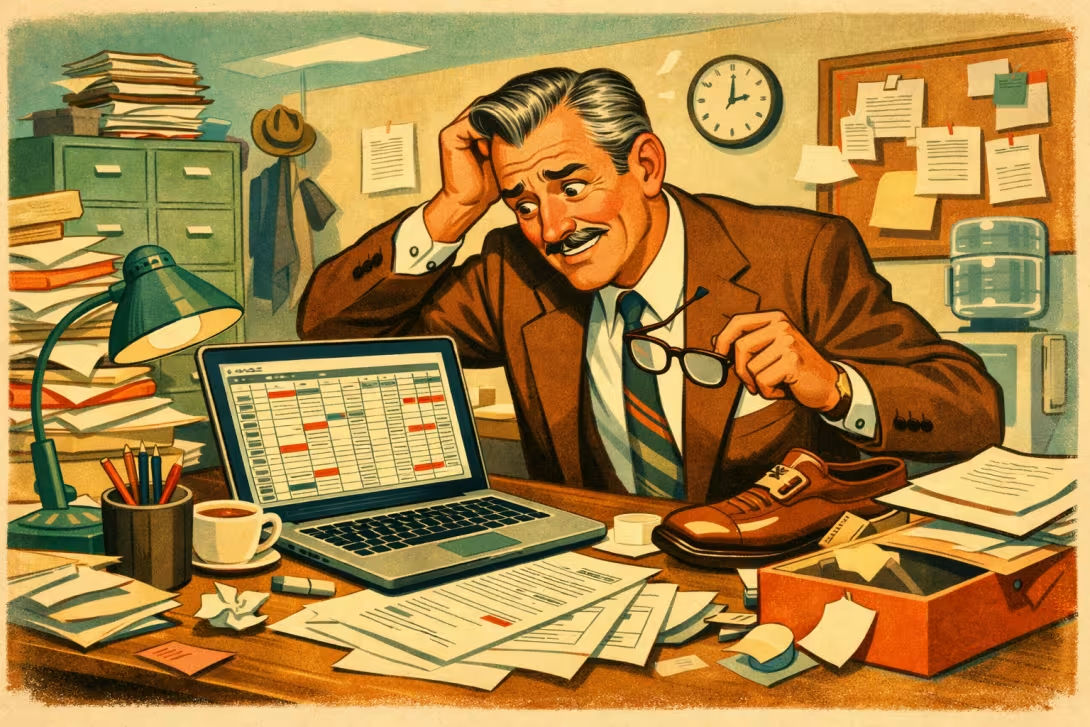
He was hit by a beer truck.
Simple question. You paid someone to build your website. Or you're paying someone every month to keep it running. Maybe both.
If you stopped paying tomorrow, what would you have?
Take a moment with that question. It is not rhetorical.
For a lot of organizations the honest answer is: not much. A domain name, maybe. A logo file somewhere on someone's laptop. Five years of content, carefully written, lovingly maintained, living inside a system that has no particular interest in helping you take it anywhere else. The website exists. You just don't own it. You rent it. And like most rental agreements, the terms favor the landlord.
This is called vendor lock-in. It is not an accident. It is a business model.
There are two kinds of platforms you can build a website on. The distinction is not technical. It is about ownership.
The first kind is a proprietary platform. A company built it, a company owns it, and you pay that company for the right to use it. The software runs on their servers. Your content lives in their database, in their format, in their system. The platform is the product and you are the customer — which means the moment you stop being a customer, your relationship with your content becomes complicated.
The second kind is open source. Nobody owns it. Thousands of people built it, and they gave it away. The software runs on your server. Your content lives in your database, in an open format, in a system that anyone with the right skills can work on. The platform is a tool and you are the owner — which means the relationship between you and your content is permanent and unconditional.
Drupal is the second kind.
The lock-in moment doesn't announce itself. It arrives quietly, usually during a budget conversation or a staff transition or a moment when you realize the platform you chose five years ago no longer does what you need it to do.
You decide to leave. You start asking questions about export tools. You discover that your content can be exported — in a format that only makes sense inside the system you're leaving. Or the export tool costs extra. Or it exists but the resulting file is so tangled that migrating it somewhere useful would cost more than staying. Or the vendor helpfully points out that they offer a premium tier that does the things you now need, and by the way your renewal is coming up.
You did not pay for a website. You paid for a relationship you cannot afford to end.
Now consider the beer truck.
Every organization has one person who knows where everything is. They know the login credentials, the hosting account, the name of the person at the development company, the reason the homepage has that one section that nobody is allowed to touch. They have been there since the beginning. They are invaluable.
Then one day they aren't there anymore. It doesn't have to be a beer truck. It can be a retirement, a better offer, a family situation, a reorganization. The result is the same. You are holding the keys to a system nobody left instructions for.
With a proprietary platform, you call their support line and hope. With an open source platform, you call any qualified developer, hand them the server credentials, and they get to work. The site doesn't care who's driving. The code is standard. The database is open. The files are where files always are. Any competent person can pick it up.
This is not a small thing. For a nonprofit, a religious organization, a small business, a government agency — any organization that depends on institutional continuity and doesn't have an IT department — this is everything.
The same logic works in every direction.
You can start with a vendor and bring it inhouse when you have the staff. You can run it inhouse and bring in a vendor when you don't. You can fire your development company on a Friday and have a new one onboarded by Wednesday. You can get three competing bids for the same project and choose the one that serves you best, knowing that the winner has no leverage over you that you didn't give them.
The vendor relationship, with an open source platform, is always optional. They are working for you. Not the other way around.
Remember the node. Remember the spreadsheet. Your content is rows in a database that sits on a server that you control. You can export it. You can move it. You can hand it to anyone with the skills to work with it. You can back it up tonight and restore it tomorrow on completely different infrastructure if you need to.
The data was always yours. That is not a feature. That is a philosophy.
Open source is not free as in free lunch. Nobody is pretending there are no costs — hosting, development, maintenance, the occasional consultant. Those costs are real.
It is free as in freedom. Free to move. Free to choose. Free to own the thing you built and take it with you when circumstances change.
And circumstances always change.